
mRNA vaccine mediated in vivo dendritic cell reprogramming to elicit potent antitumor immune responses

Research from Dr. Xueqing Zhang’s group at Shanghai Jiao Tong University on mRNA vaccine mediated in vivo dendritic cell reprogramming to elicit potent antitumor immune responses was published in ACS Nano
        Antigen-specific cytotoxic T lymphocytes (CTL) play a central role in antitumor immunity by precisely recognizing and eliminating tumor cells. However, current immunotherapies still face two major bottlenecks: (i) the lack of efficient in vivo antigen presentation strategies, and (ii) the limited activation and expansion capacity of antigen-specific CD8⁺ T cells. Although ex vivo dendritic cell (DC) vaccines and adoptive T cell therapies have been extensively investigated and can enhance immune responses through engineering approaches, they are constrained by complex in vitro procedures, prolonged expansion cycles, and challenges in large-scale production due to personalization. Therefore, developing an “off-the-shelf” strategy capable of directly inducing the generation and expansion of antigen-specific T cells in vivo has become an urgent need in the field.
        Recently, a collaborative study by Professor Zhang Xueqing’s team at Shanghai Jiao Tong University School of Pharmacy and Professor Xu Xiaoyang’s team at New Jersey Institute of Technology was published in ACS Nano , entitled “mRNA-Based Vaccination Drives In Vivo Dendritic Cell Reprogramming and Selective Cytotoxic T Lymphocyte Modulation for Enhanced Antitumor Immunity.” This study innovatively proposes a strategy termed “Vaccination-Initiated Selective T Cell Modulation” (VISIT), which leverages mRNA-LNP technology to achieve in vivo DC reprogramming, thereby modulating T cell immune responses and enabling the in situ generation and expansion of antigen-specific CTLs. This platform provides a universal solution for efficiently inducing and amplifying tumor-specific CTL responses in vivo, demonstrating significant potential for clinical translation. The first author of the paper is Dr. Zhang Chenshuang from Shanghai Jiao Tong University School of Pharmacy, which also serves as the primary and corresponding institution.

        The spleen, as the largest secondary lymphoid organ in the body, is enriched with DCs and T cells and represents an ideal physiological site for initiating T cell responses via MHC-I-mediated antigen presentation on DCs. In this study, optimized lipid nanoparticles were employed to selectively deliver mRNA encoding tumor antigens and a membrane-bound IL-15/IL-15Rα complex (bIL-15, the biologically active form of IL-15) into splenic DCs. Following systemic administration, the VISIT platform successfully achieved in vivo DC reprogramming, enabling the simultaneous presentation of antigen/MHC-I complexes and bIL-15 on the DC surface. This “two-in-one” design allows DCs to trans-present both tumor antigens and bIL-15 to CD8⁺ T cells, thereby effectively promoting the in situ generation and expansion of antigen-specific CTLs, driving tumor clearance and immune memory formation, while minimizing the risk of nonspecific immune activation.
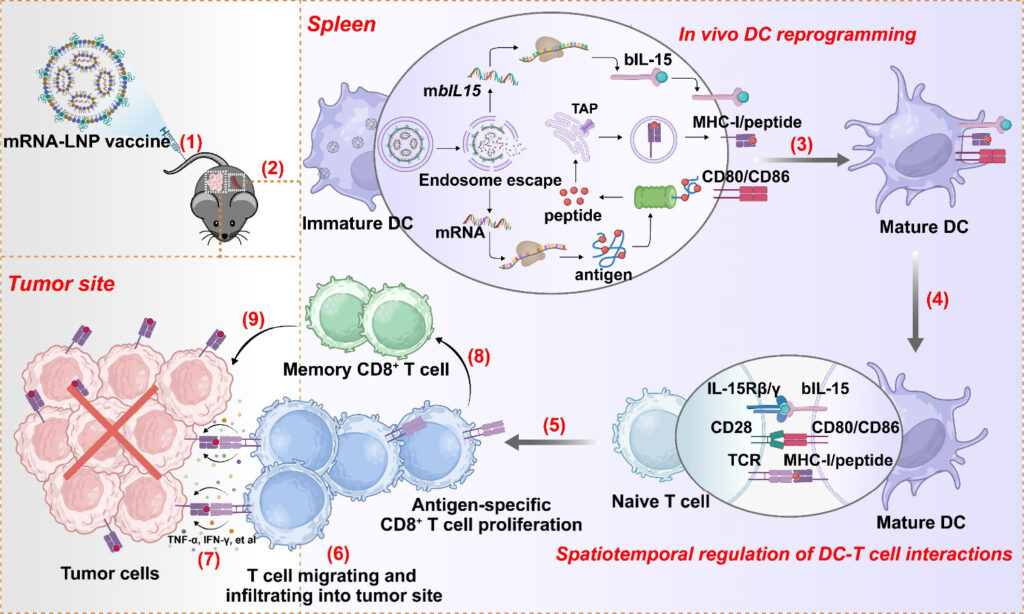
        In vivo experiments demonstrated that, following systemic administration, the mRNA-LNP vaccine achieved a protein expression efficiency of up to 96% in the spleen and successfully transfected approximately 33% of DCs. Further mechanistic studies revealed that the VISIT strategy not only promotes DC maturation and antigen presentation but also enables the programmed delivery of bIL-15 specifically to antigen-specific CD8⁺ T cells, thereby significantly enhancing CTL expansion and antigen-specific humoral immune responses. In prophylactic vaccination settings, the vaccine completely inhibited tumor growth and induced long-lasting memory T cell responses, providing effective protection against tumor rechallenge. In both the MC38-OVA colorectal cancer model and the highly aggressive B16F10 melanoma model, therapeutic vaccination significantly enhanced CTL responses, effectively delayed tumor progression, and prolonged survival. Notably, when combined with immune checkpoint inhibitors, the vaccine exhibited synergistic antitumor effects, further improving therapeutic efficacy in the melanoma model.
        In summary, the VISIT vaccine platform enables precise spatiotemporal regulation of DC–T cell interactions, offering a novel in vivo DC reprogramming strategy for the development of personalized cancer immunotherapy. This platform not only provides a universal technological framework for individualized immunotherapy but also holds promise as an effective combinatorial approach with adoptive T cell therapies.

Original article link: https://pubs.acs.org/doi/10.1021/acsnano.5c09365#