
Research from Dr. Xueqing Zhang’s group at Shanghai Jiao Tong University on inhalable RNA therapeutics overcoming immunotherapy barriers in lung cancer was published in Nature Communications
Although immunotherapy has achieved breakthrough progress in tumor treatment, its application in solid tumors still faces major challenges. Excessive deposition and crosslinking of the extracellular matrix (ECM) in solid tumors form a dense physical barrier that restricts the infiltration of immune effector cells such as T cells into the tumor interior. Even when some T cells are able to enter the tumor, their function is often constrained by the immunosuppressive microenvironment, resulting in significantly weakened antitumor effects. Consequently, the clinical efficacy of CAR-T therapy in solid tumors has consistently failed to recapitulate its breakthrough success in hematological malignancies. In addition, the lack of organ-specific delivery systems greatly limits drug accumulation at lesion sites. Taking lung cancer as an example, under systemic administration, drug distribution at the lesion site is limited, making it difficult to achieve the required level of pulmonary delivery and maintain effective drug concentrations, thereby further increasing the difficulty of treatment.
Recently, the team led by Zhang Xueqing at the School of Pharmacy, Shanghai Jiao Tong University, in collaboration with Xu Xiaoyang’s group at the New Jersey Institute of Technology, published a research article in Nature Communications entitled “Modulating Tumor Collagen Fiber Alignment for Enhanced Lung Cancer Immunotherapy via Inhaled RNA.” This study developed an inhalable lung-targeted RNA therapeutic strategy that combines mRNA-mediated antibody therapy with siRNA-mediated immune checkpoint blockade, effectively overcoming both physical and immunological barriers in lung cancer treatment and significantly enhancing local immune responses, thereby providing a novel strategy and promising application prospects for lung cancer immunotherapy. Hu Bin, a Ph.D. candidate at the School of Pharmacy, Shanghai Jiao Tong University, is the first author of the paper, and the School of Pharmacy, Shanghai Jiao Tong University serves as the primary and corresponding institution.
Discoidin domain receptor 1 (DDR1) is a receptor tyrosine kinase that is highly expressed in multiple solid tumors. Its extracellular domain (ECD) can be shed under the action of metalloproteinases and bind to collagen, thereby inducing dense and ordered alignment of collagen fibers and forming a physical barrier around tumors that restricts T cell infiltration. To overcome this barrier, the researchers designed an anti-DDR1 single-chain antibody (anti-DDR1 scFv) and an mRNA encoding the anti-DDR1 single-chain antibody (mscFv), and co-encapsulated them with siRNA targeting PD-L1 (siPD-L1) into inhalable lipid nanoparticles (LNPs) suitable for respiratory delivery of RNA to the lungs, which were then administered via inhalation to deliver them to lung tumor lesions. Transfected tumor cells can secrete anti-DDR1 scFv, which binds to the DDR1 ECD and blocks its interaction with collagen, thereby modulating the alignment pattern of pulmonary collagen fibers and the mechanical properties of tumor tissues, reducing the ECM barrier effect and remodeling the tumor microenvironment to favor immune cell infiltration. Meanwhile, siPD-L1 can silence PD-L1 expression in tumor cells, alleviating immunosuppression and enabling infiltrating T cells to exert cytotoxic effects. This work establishes a novel therapeutic strategy of “inhalation-targeted delivery–matrix remodeling–immune activation,” which significantly enhances antitumor immune responses by synergistically alleviating both the physical barrier and immunosuppression in the lung cancer tumor microenvironment.
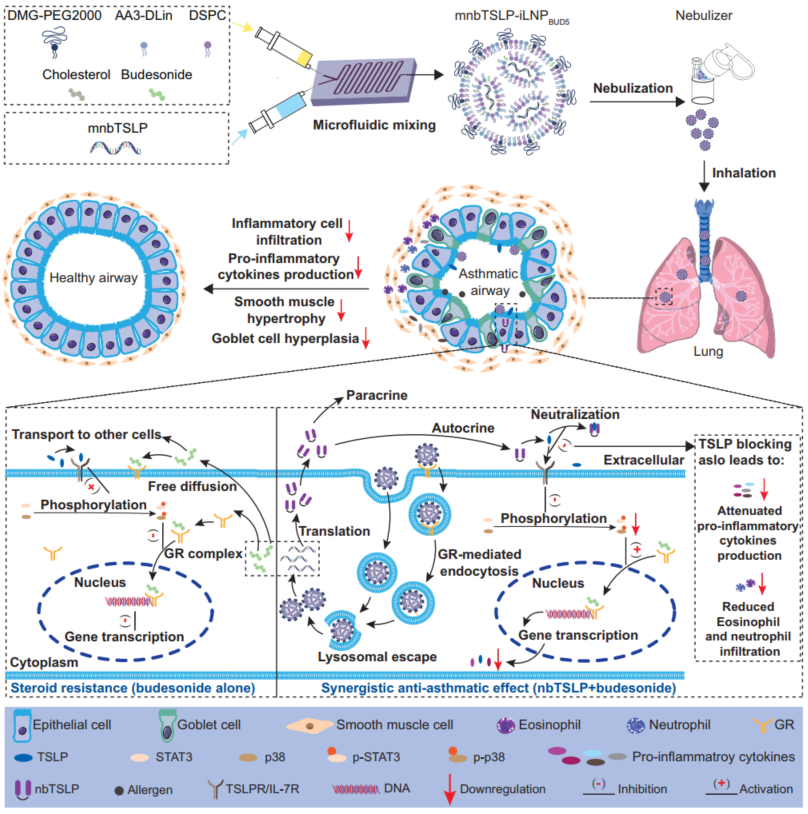
In orthotopic and metastatic lung cancer mouse models, inhaled mscFv/siPD-L1@LNP effectively reduced the alignment coefficient and length of collagen fibers in the tumor ECM and weakened the mechanical strength of tumor tissues, thereby significantly promoting the infiltration of immune effector cells such as T cells, NK cells, and NKT cells. At the same time, by reducing the levels of immunosuppressive cells and immunosuppressive molecules in the tumor microenvironment, it synergistically enhanced antitumor immune responses, ultimately effectively inhibiting tumor growth and prolonging overall survival in mice.
Given that many cancers commonly exhibit unfavorable tumor microenvironments characterized by insufficient immune infiltration and immunosuppression, this strategy demonstrates broad application potential in solid tumor therapy and provides new insights for improving cancer immunotherapies with limited clinical efficacy.
Original article link: https://www.nature.com/articles/s41467-025-63415-0